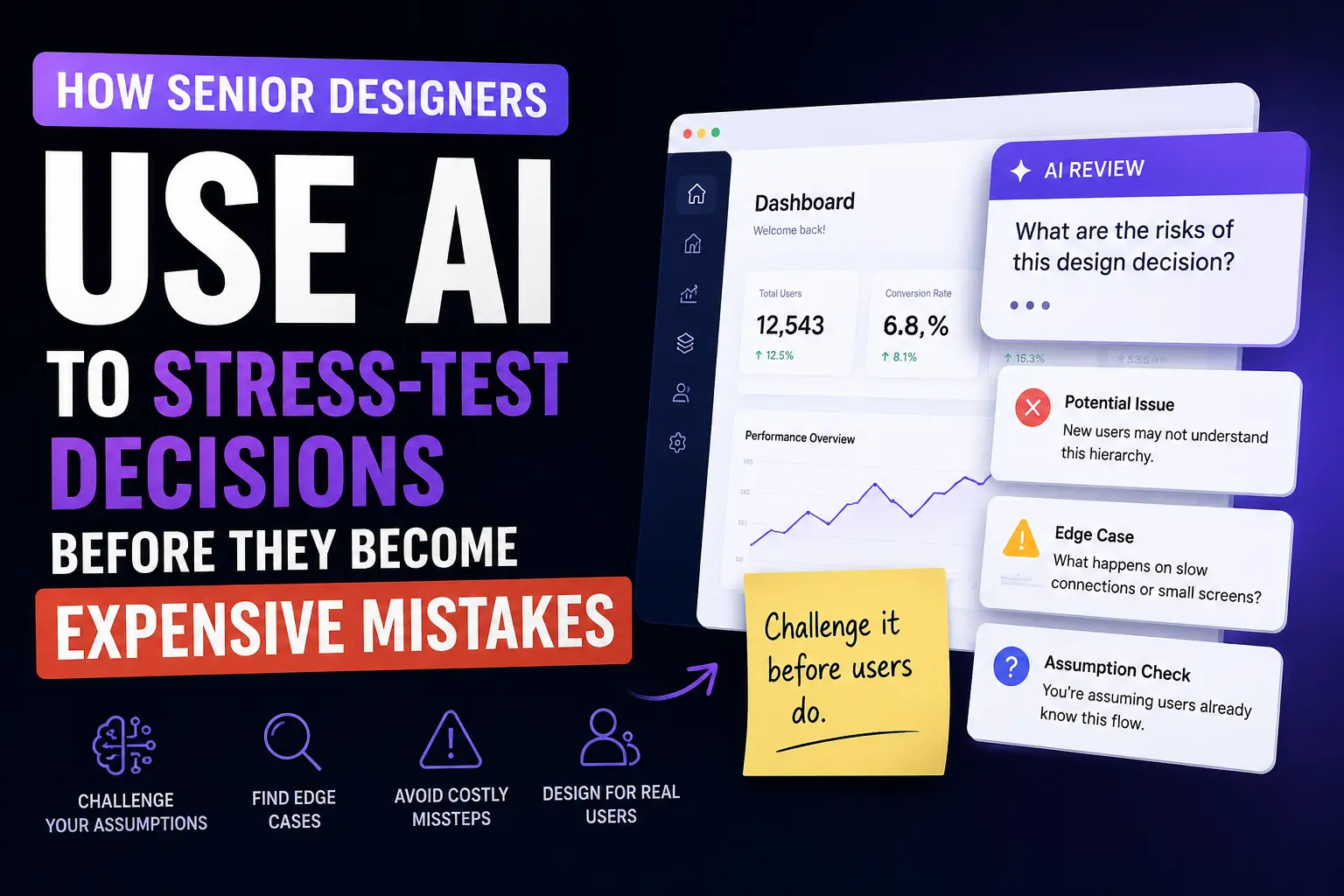
There’s a quiet crisis happening in design right now — and most designers are too busy shipping screens to see it.
For years, the ladder was clear. Junior designers learned the tools. Mid-level designers got faster. Senior designers got precise, consistent, and efficient. Seniority was defined, in large part, by how well you could execute.
That definition just broke.
In 2026, 56% of companies hiring senior designers are looking for something that has nothing to do with execution speed, tool mastery, or pixel precision. They want designers who think like product owners — who enter the problem before the brief arrives, not after.
And the reason this shift is happening now, specifically, is AI.
What AI did to execution
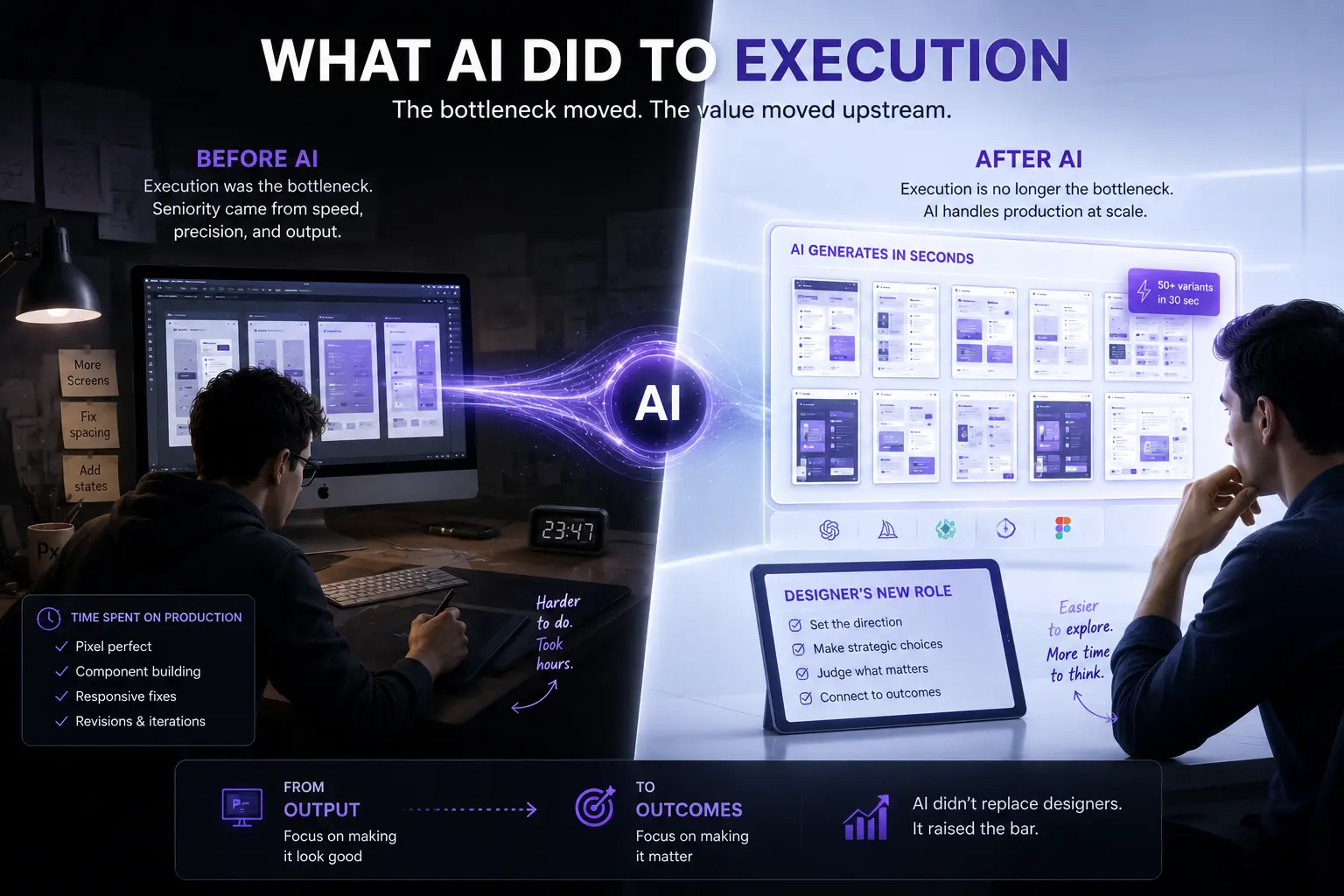
When AI can generate fifty layout variations in thirty seconds, the bottleneck is no longer production. The thing that separated senior designers from juniors — speed, consistency, the ability to produce high-quality work at volume — is now something any designer can access through a prompt.
Figma’s State of the Designer 2026 report found that 72% of designers now use generative AI in their workflows, and 91% say it improves the quality of their outputs, not just their speed.
That last part is the uncomfortable implication nobody wants to say directly: if AI improves quality, not just speed, then the quality ceiling that defined seniority has been raised for everyone simultaneously. The execution gap between a strong junior designer using AI and a strong senior designer using AI is smaller than it’s ever been.
This doesn’t mean execution doesn’t matter. It means execution alone no longer differentiates you.
What actually matters now
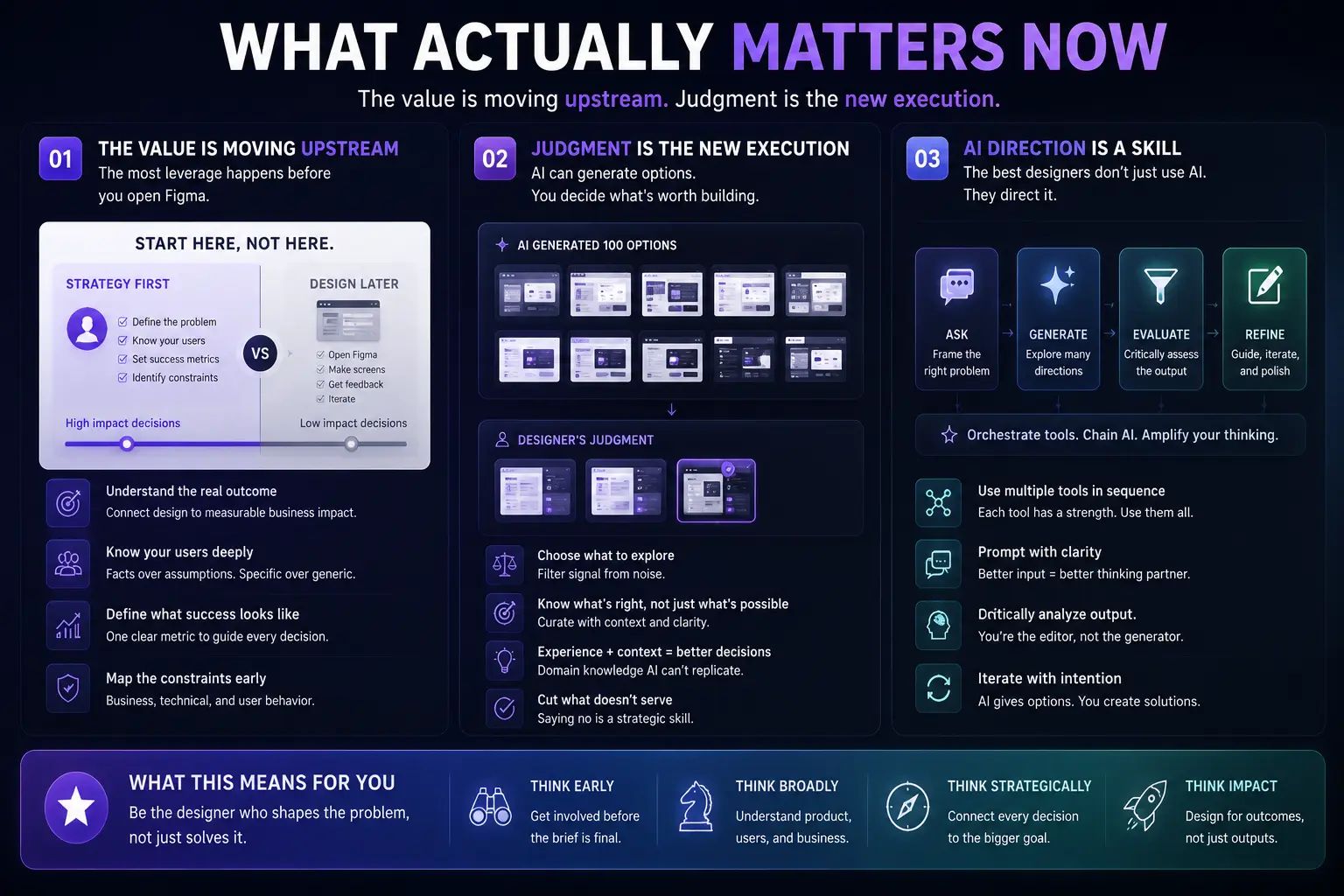
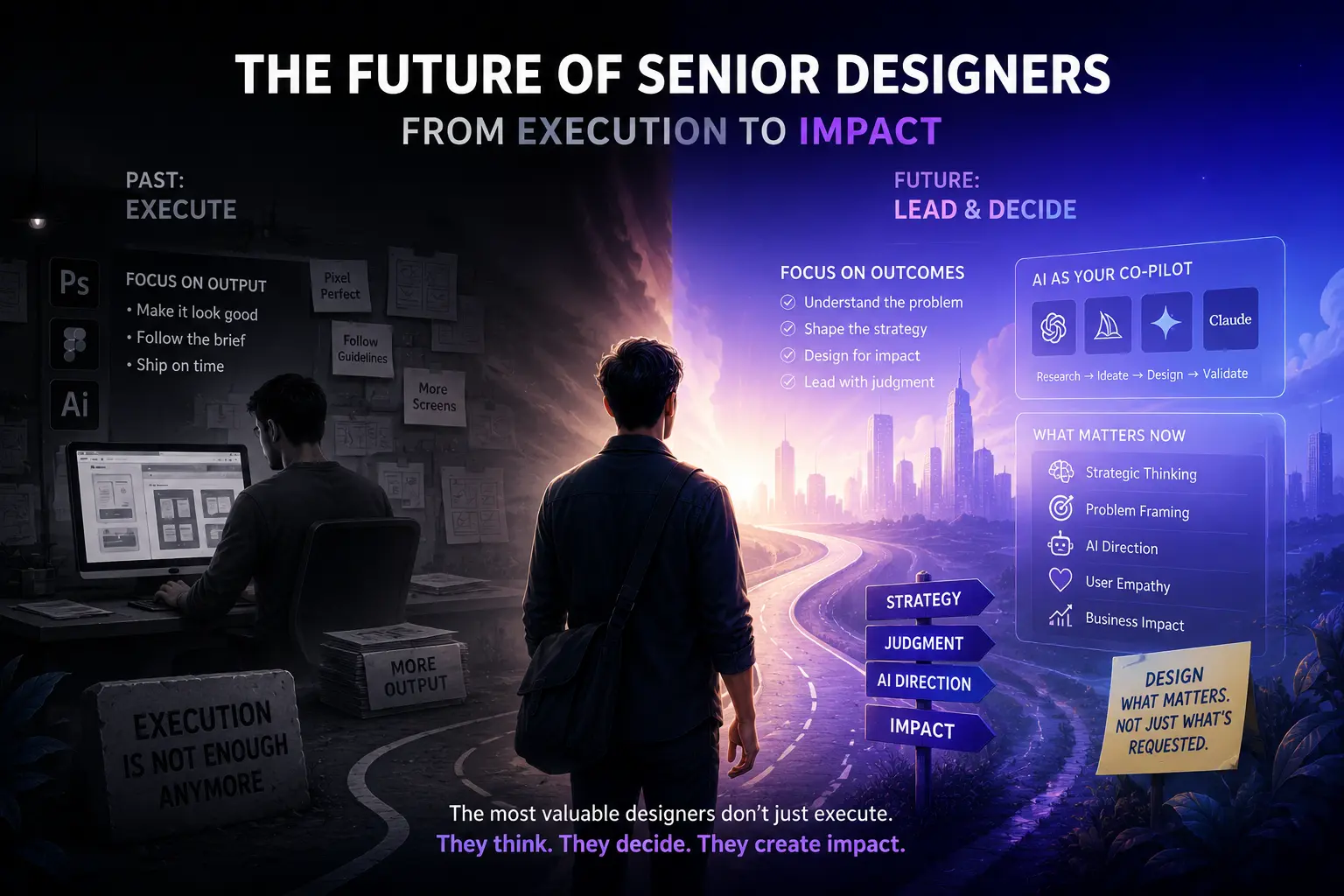
Design automation handles production tasks. Strategic, empathetic, and judgment-driven work is growing in value. Senior design roles are expanding — the job is evolving toward AI direction and creative oversight.
Translated into what this means for your daily practice:
The value is moving upstream. The most leveraged moment in any design project is before a frame is opened in Figma. What problem are we actually solving? Who is the user, specifically? What does success look like in measurable terms? What constraints will this design need to navigate? Designers who can answer these questions — and shape the brief rather than receive it — are the ones companies are paying a premium for.
Judgment is the new execution. “The value of a designer in 2026 is not the ability to produce — it is the ability to judge, to choose, to know what to keep and what to discard.” When AI can generate a hundred directions, the designer’s job is to know which ten are worth exploring and which one is right. That’s a curatorial, strategic skill. It can’t be automated. It’s developed through practice, feedback, and deliberate exposure to the full context of product decisions.
AI direction is a skill. The most powerful AI workflow in 2026 isn’t using one tool well — it’s orchestrating multiple specialized tools in sequence, each contributing what it does best. Knowing how to prompt effectively, how to evaluate AI output critically, how to chain tools from strategy through generation through refinement — this is a craft. And right now, most designers haven’t developed it intentionally.
The gap this is exposing
Many designers spent years perfecting execution skills but never developed strategic ownership. The designers thriving today combine multiple capabilities: they understand product strategy, they use AI tools to accelerate workflows, they design for measurable outcomes, and they think in terms of systems and behaviors — not just screens.
This is the gap. And it’s not about seniority level — it cuts across mid-level and senior designers equally. The common thread is designers who spent their careers optimising for being good at Figma, and not enough time developing an opinion about what should be in Figma and why.
The good news is the gap is closeable. But it requires a deliberate shift in where you put your attention.
How to start thinking upstream
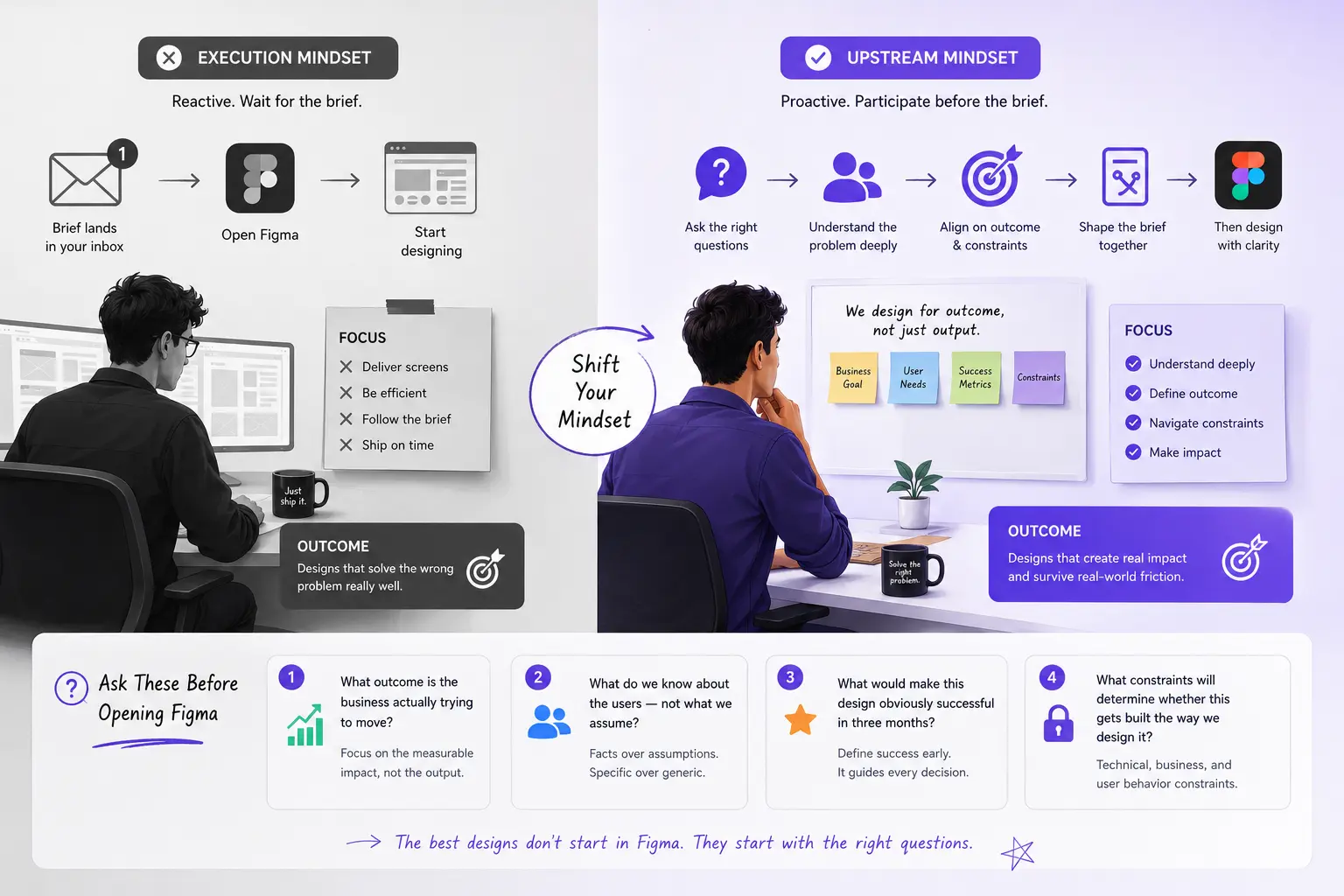
The practical shift is simpler than it sounds. It starts with one habit: participate before the brief arrives.
Most designers wait. A brief lands in their inbox. They open Figma. They start designing. This is the execution mindset — receiving problems and producing outputs.
The strategic mindset looks different. Before the brief is finalized, you’re asking questions:
- What outcome is the business actually trying to move?
- What do we know about the users — not what we assume, what we actually know?
- What would make this design obviously successful in three months?
- What constraints will determine whether this gets built the way we design it?
These questions aren’t UX questions. They’re product questions. And the designers who ask them before a single frame is opened are the ones who end up making design decisions that survive contact with engineering, leadership, and real users.
Using AI to accelerate strategic thinking — not just production
Here’s the reframe most designers miss: AI isn’t just faster Figma. Used well, it’s a thinking tool that accelerates the strategic work, not just the execution.
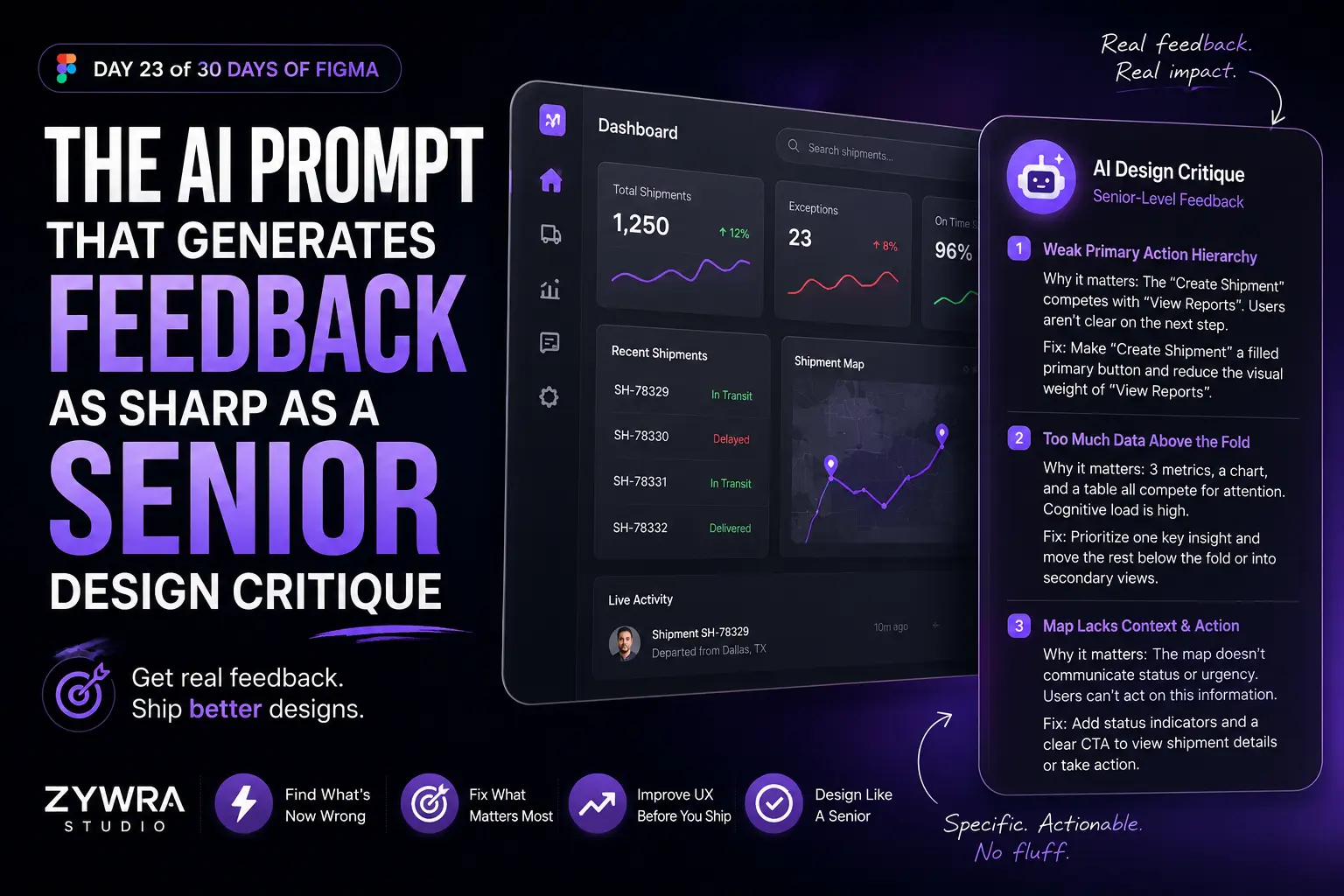
Before opening Figma on any new project, give an AI this prompt — filling in the brackets with your actual project context:
I’m designing [product/feature] for [company type]. The business goal is [measurable outcome]. The primary user is [specific role/persona].
Before I open Figma, help me think through: the three biggest assumptions baked into this brief; the user needs this design must address vs. the ones it can defer; the one metric that would tell us in 90 days whether this worked; and the constraints — technical, business, user behaviour — that will shape what’s actually feasible.
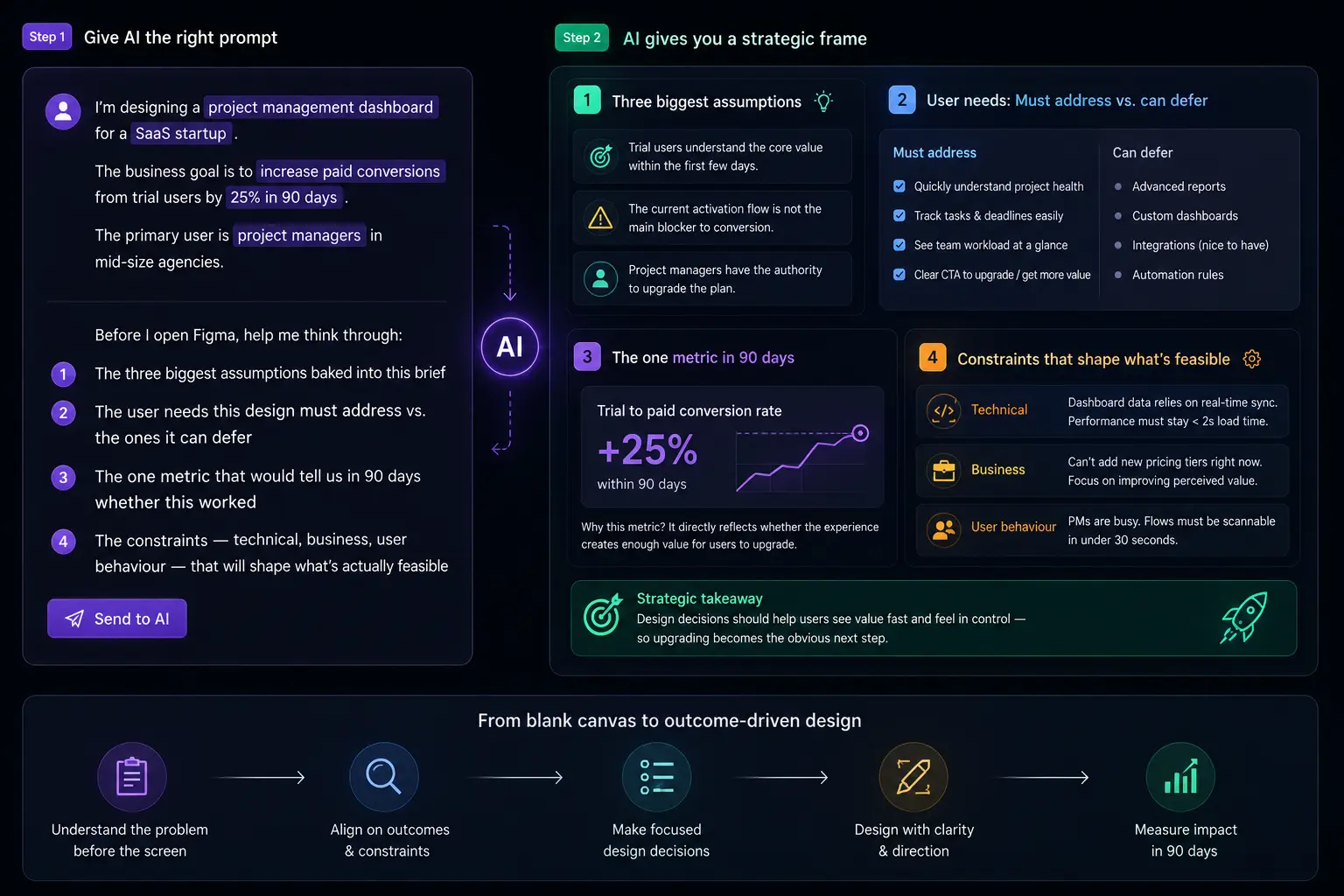
This takes five minutes. What it produces is a strategic frame for every decision you make in Figma. Not a vague brief — a structured set of stakes that keeps your design anchored to outcomes rather than outputs.
That’s the work companies are paying for. Not the Figma skills. The thinking that directs the Figma skills.
The honest implication
If you’ve spent the last three years getting really good at Figma — components, Auto Layout, prototyping, design systems — those skills still matter. They’re the foundation. But they’re no longer the ceiling.
The ceiling now is how much of the product problem you can own. How far upstream you can push your involvement. How clearly you can connect a design decision to a business outcome. How precisely you can direct AI to produce work that reflects strategic clarity, not just aesthetic competence.
The designers producing the most valuable work in 2026 are the ones who’ve figured out how to blend AI capabilities with human creativity — using AI to generate unexpected starting points and handle production work while they focus on creative direction.
The shift is already happening. The question is whether you’re ahead of it or catching up to it.
What’s next
Day 26 covers the exact AI workflow that turns a raw brief into a full UX strategy document — problem framing, user model, success metrics, and design principles — in under 10 minutes. The workflow that lets you walk into any product conversation already three steps ahead.
Published by ZywraStudio · zywra.com Follow on Instagram for daily design + AI tips: #ZywraStudio