
Imagine this: you’ve been freelancing for two or three years. Your work is noticeably better than when you started. Clients are happy. Referrals come in. You occasionally see newer freelancers — with less experience and a thinner portfolio — charging significantly more than you do.
You know your rates are too low. You’ve known for a while. But every time you think about raising them, something stops you. What if the client says no? What if they leave? What if new clients stop enquiring because the price feels too high?
You’ve probably experienced this exact hesitation — the gap between knowing your rates should be higher and actually changing them. The frustrating part is, that gap rarely closes on its own. Most freelancers who stay underpriced for years don’t stay there because they lack skill. They stay there because raising rates feels riskier than it actually is, and nobody ever walked them through how to do it practically.
Why Freelancers Stay Stuck at Low Rates for Too Long

Most freelancers assume that the right time to raise rates is when they feel completely confident, fully booked, and certain the client won’t leave. In reality, that moment of perfect confidence almost never arrives on its own — because the fear of losing a client doesn’t disappear just because your skills improve.
Imagine a freelance web developer who set her rates when she was just starting out, two years ago, to stay competitive and get her first few clients. Those rates made sense then. But she’s now faster, more capable, and producing significantly better work — while still charging what a beginner would charge. She hasn’t raised her rates because her current clients seem happy and she doesn’t want to disrupt something that feels stable.
This happens because the logic that made low rates useful at the start — attracting clients when there was no reputation to rely on — quietly becomes the habit that persists long after that logic has expired. Low rates feel safe because they’re familiar. But familiar isn’t the same as right.
How Do You Know If Your Freelance Rates Are Overdue for an Increase
The signs are usually visible long before most freelancers act on them:
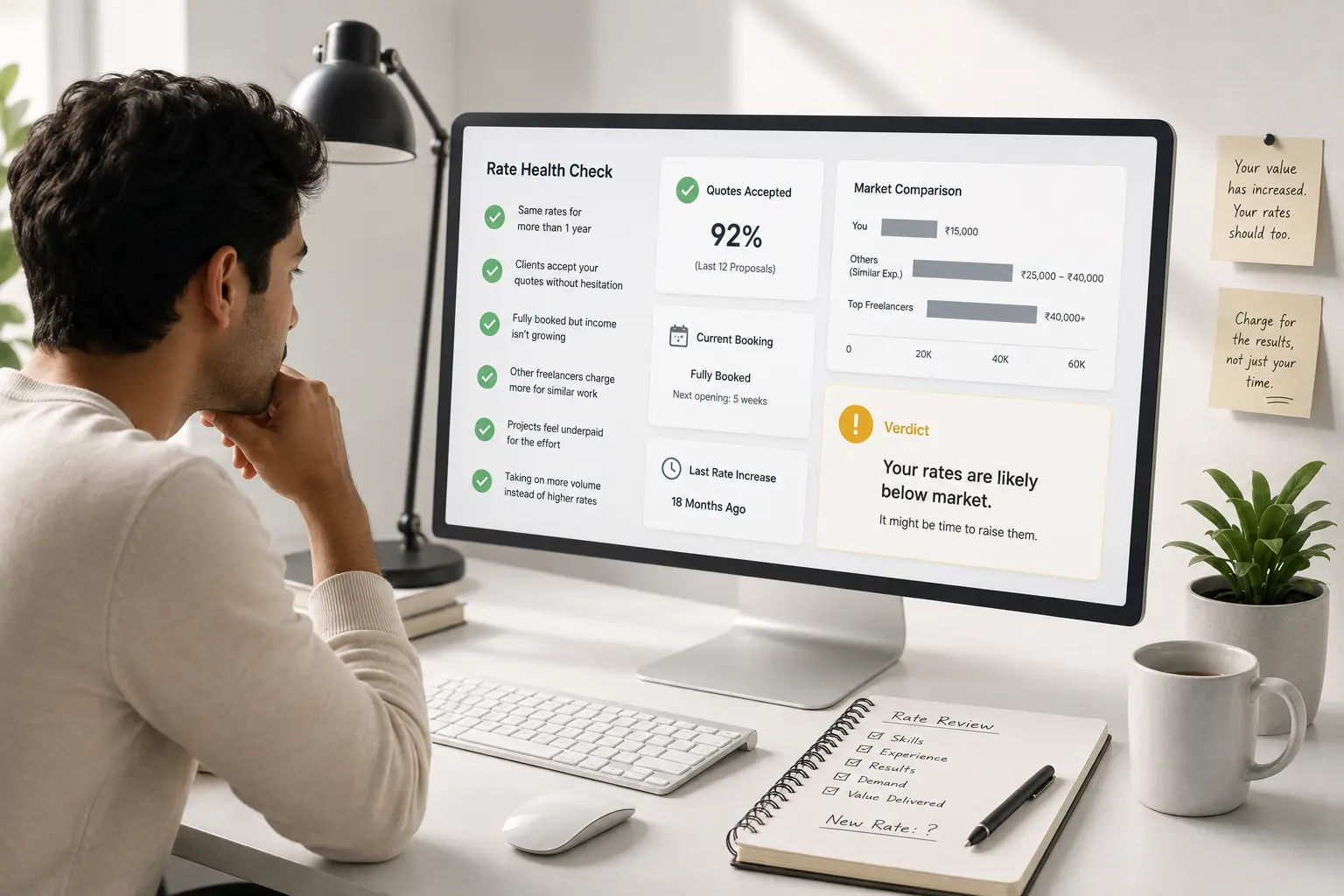
- You’ve been charging the same rates for more than a year without any adjustment
- Clients accept your quotes without hesitation or negotiation — almost every time
- You’re fully or nearly fully booked but your income isn’t growing
- You’ve seen other freelancers with similar or less experience charging noticeably more
- You feel mild resentment toward certain projects because the pay doesn’t reflect the effort involved
- You’re taking on more volume to increase income instead of increasing what individual projects pay
Imagine a freelance content writer who quotes the same per-article rate she’s charged for eighteen months. Clients almost never push back on the price — which, if she thought about it carefully, would tell her the rate is almost certainly lower than what the market would accept. When clients accept without negotiating, the rate isn’t at the ceiling — it’s still well below it.
Common Mistakes Freelancers Make When Thinking About Raising Rates
- Waiting for permission — assuming clients will signal when it’s time, instead of making the decision themselves
- Raising rates and immediately apologising for it, which undermines the increase before the client has even reacted
- Raising rates for all clients at once instead of introducing new rates with new clients first
- Underestimating how rarely clients actually leave over a reasonable price increase with proper notice
- Confusing a client’s budget with their ceiling — many clients have more flexibility than they initially present
- Comparing rates to the lowest-priced competitors instead of to the value being delivered
- Never articulating what’s changed — a rate increase with no context feels arbitrary; one that comes with a clear explanation of experience, demand, or scope feels reasonable
How to Raise Your Freelance Rates Without Losing the Clients You Want to Keep
1. Start with new clients, not existing ones.
The simplest and least stressful way to begin raising rates is to quote your new rate to the next new enquiry — before touching existing client arrangements at all. This lets you test how the market responds without any relationship risk. Most freelancers find that new clients accept higher rates far more readily than they expected.
2. Give existing clients advance notice, not a sudden change.
When you do raise rates for existing clients, a four to six week heads-up with a brief, matter-of-fact explanation is usually all that’s needed. Something like: “From [date], my rate will be moving to [new rate] to reflect the current scope of work I take on. I wanted to give you plenty of notice to plan ahead.” No apology, no over-explanation — just clear and professional.
3. Raise rates when you have evidence to point to.
Imagine a freelance photographer who raises his rates after completing a particularly strong portfolio project and receiving three unsolicited referrals in a single month. Those aren’t coincidences — they’re evidence that the market values his work at a higher level than his current pricing reflects. Evidence makes the internal decision easier and the client conversation more grounded.
4. Don’t discount the increase if a client pushes back immediately.
A client’s first reaction to a price increase is often resistance — that’s normal and doesn’t mean they’ll leave. Give them time to consider it rather than immediately offering to hold the old rate. Many clients who initially push back come back and accept the new rate once they’ve thought about the inconvenience of switching to someone else.
5. Reframe what you’re pricing.
The shift from “I charge per hour” or “I charge per piece” to “you’re investing in the outcome this produces” is a small language change that meaningfully changes how both the freelancer and the client think about the rate. Clients don’t pay plumbers by the hour because of how long they take — they pay because the pipe works afterward. The rate reflects the result, not just the time.
What Most Business Owners Overlook
Here’s the part most freelancers miss: the clients who leave when you raise your rates are almost always the ones you could most afford to lose — and the ones who stay are usually the ones who valued the work, not just the price.
Most freelancers overestimate how many clients will leave after a rate increase and underestimate how much capacity those departures create for better-fit clients at the right price. A freelance career often genuinely improves after the first meaningful rate increase — not just financially, but in the quality and type of work that comes in, because higher rates attract clients who are investing seriously rather than shopping for the lowest possible option.
Timeline: What to Expect When You Raise Your Freelance Rates
Introducing a new rate to new clients can happen immediately and typically gets a clear response — acceptance or negotiation — within the first few enquiries. Most freelancers know within two to four weeks whether the new rate is landing well with the market.
For existing clients, allow four to six weeks of notice before the new rate takes effect. Expect a small number of clients to push back, a smaller number to leave, and the majority to continue — particularly if the working relationship has been good and the increase is reasonable rather than sudden.
The financial impact of a rate increase usually becomes clearly visible within one to two billing cycles. The longer-term effect — attracting a different quality of client and reducing the volume of low-margin work — typically becomes apparent over three to six months of operating at the new rate consistently.
What Happens If You Ignore This Problem
Rates stay where they were set years ago, when experience was lower and reputation was unestablished. Income grows only by taking on more volume — more clients, more projects, more hours — rather than by the work itself being valued more accurately. Over time the gap between what the work is worth and what it’s being charged at widens, and closing it becomes harder because the expectation has been set low for longer. The freelancer stays busy, stays underpaid relative to their actual skill level, and quietly burns out doing more work than the income justifies.
A Quick Action Step
Find the last three proposals you sent and look at the rate you quoted. Now ask yourself honestly: if a client came to you today with the same brief, having seen your current portfolio and knowing your current experience level, would you quote the same number? If the answer is no — even quietly, even slightly — that gap is where your next rate increase begins.
Tools & Resources
- A simple rate review document — A one-page private document noting your current rates, when they were last changed, your current booking level, and what comparable freelancers in your space are charging. Reviewing this once a quarter makes rate decisions feel less like guesswork and more like a normal business practice.
- Your own analytics or booking data — If you’re consistently fully booked more than a month in advance, that’s one of the clearest market signals that your rates are below where demand would support them. Your own enquiry and booking patterns are often the best data available.
- Freelance community benchmarks — Communities and forums for freelancers in your specific field often share rate discussions openly. Knowing what others with similar experience in similar markets are charging removes the guesswork from deciding where your new rate should land.
FAQ
How much should I raise my rates by?
There’s no universal amount, but ten to thirty percent is a range most freelancers can implement without significant client loss — particularly if they haven’t raised rates in a year or more. A larger jump may make sense if the gap between current rates and market rates is significant.
Should I explain why I’m raising my rates to existing clients?
A brief, professional explanation helps — but it doesn’t need to be elaborate. Mentioning increased demand, scope of work, or simply that your rates are being updated to reflect current market levels is usually enough. Avoid over-explaining or apologising.
What if a client says the new rate is too high?
Acknowledge it calmly, hold the rate, and give them time to think. Resist the urge to immediately offer a discount or revert to the old rate. Some clients need a short period to consider the alternative — finding and briefing someone new — before accepting the increase.
Is it better to raise rates gradually or in one step?
Both work. Gradual increases — a smaller adjustment every six to twelve months — tend to feel less disruptive to existing clients. A single meaningful increase is faster to implement and sometimes more effective at repositioning how your work is perceived in the market.
I’m worried about losing a long-term client if I raise rates. What do I do?
Long-term clients who value the relationship and the consistency of working with you are often the most likely to accept a reasonable increase with proper notice. The ones most likely to leave are those who were primarily price-driven — and those relationships are usually the most draining anyway.
When is the wrong time to raise rates?
Raising rates when you’re underbooked and actively looking for new work creates unnecessary pressure. The better time is when you’re consistently busy, receiving steady enquiries, or turning down work — those are the conditions where the market is signalling that demand is there.
Key Takeaways
- Most freelancers stay underpriced not because their work isn’t good enough but because the habit of low rates outlasts the logic that originally made them necessary
- Starting with new clients rather than existing ones is the lowest-friction way to begin increasing rates
- Clients accepting quotes without negotiation is often a signal the rate is still below what the market would support
- A small number of clients will leave after a rate increase — they are almost always the lowest-margin, highest-effort ones
- The financial and quality-of-work improvements from a rate increase typically become clearly visible within one to three months
Conclusion
Your rates are a decision, not a fixed feature of your freelance career. They should move as your experience, reputation, and demand move — and if they haven’t been reviewed in a year or more, they’re almost certainly behind where they should be.
Start with the next new enquiry. Quote what the work is actually worth, not what you charged when you were just getting started. That single moment — hitting send on a higher number than usual — is usually less dramatic than the months of hesitation that precede it.